Delhi to Ranthambore Travel Guide: Safaris, Trains & Cars
Planning a wildlife expedition from the national capital to the historic scrublands of Sawai Madhopur requires deliberate logistical preparation. Ranthambore National Park remains one of India's premier tiger reserves, encompassing dry deciduous forests, rocky hills, and ancient ruin complexes centered around the UNESCO-listed Ranthambore Fort. Navigating transit options, forest department protocols, and seasonal shifts ensures a seamless transition from the urban sprawl of Delhi into the domain of the Royal Bengal tiger.
Transit Routes from Delhi to Sawai Madhopur
Travelers departing Delhi generally choose between rail transit and direct highway driving, depending on schedule flexibility and group size.
Reaching Ranthambore by Train
Railway transit represents the most reliable and punctual mode of transportation between Delhi and Sawai Madhopur Junction (SWM), the direct railhead located roughly 14 kilometers from the reserve boundary. Superfast trains operating along the main Western Railway route depart from New Delhi Railway Station (NDLS) or Hazrat Nizamuddin (NZM).
Key train connections include:
The Kota Jan Shatabdi Express (Train 12060), departing Hazrat Nizamuddin early in the morning and arriving at Sawai Madhopur before midday, providing sufficient time for an afternoon game drive.
The August Kranti Tejas Rajdhani Express (Train 12954) and the Mumbai Central Tejas Rajdhani (Train 12952), offering swift transit in under four hours.
The Golden Temple Mail (Train 12904), providing overnight travel flexibility.
Reserving tickets well in advance via the Indian Railway Catering and Tourism Corporation (IRCTC) portal is essential, particularly between October and April when wildlife tourist traffic peaks.
Driving Routes via Highway Networks
Road journeys from Delhi to Ranthambore span roughly 380 to 410 kilometers, depending on the starting sector in the National Capital Region (NCR).
The optimal route utilizes the Delhi-Mumbai Expressway (NE-4):
Depart Delhi via the Sohna elevated corridor onto the Delhi-Mumbai Expressway.
Continue southward through Haryana and enter Rajasthan, exiting at the Lalsot or Dausa interchanges toward State Highway 24 and State Highway 1.
Traverse onward through Gangapur City or Lalsot directly into Sawai Madhopur.
Under standard conditions, this expressway route reduces driving duration to approximately five to six hours. Private vehicle hires, self-drives, or chauffeured utility vehicles provide convenient doorstep transit directly to local accommodations. For visitors seeking structured itineraries that combine reliable private vehicle transfers with scheduled safari permits and hospitality arrangements, reserving a specialized

Safari Operations and Booking Structure
Ranthambore National Park is administered by the Rajasthan Forest Department under strict carrying-capacity regulations. The reserve is divided into ten safari zones to distribute visitor density and minimize stress on resident fauna.
Safari Vehicles: Gypsy vs Canter
Two distinct vehicle configurations operate within the forest zones:
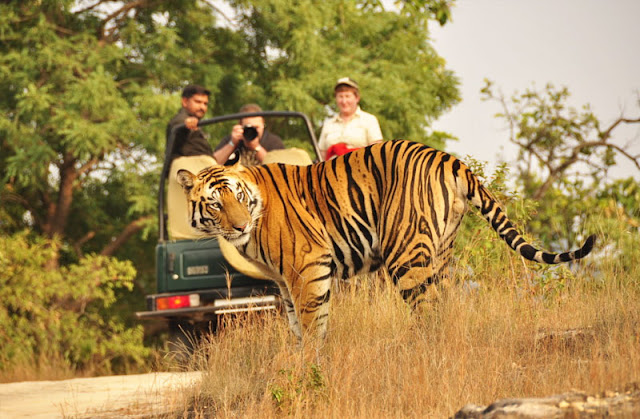
6-Seater Maruti Gypsy: Open-top four-wheel-drive utility vehicles capable of navigating steep terrain, tight forest paths, and narrower rocky switchbacks. Gypsies offer lower engine noise profiles, superior maneuvering capability, and elevated photographic vantage points.
20-Seater Canter: Open-air medium-duty trucks suitable for larger family cohorts and corporate groups. Canters remain confined to primary arterial tracks across select zones but offer economical access to prime tiger habitat.
Zone Classification Insights
The park division separates habitats into specific ecological zones:
Zones 1 through 5 represent the heritage core area, encompassing historic landmarks, Rajbagh Lake, Malik Talao, and Padam Talao. These zones feature dense water networks, higher prey biomass, and documented feline territories.
Zones 6 through 10 comprise buffer and contiguous reserve sectors across hilly terrain, open grasslands, and riverine corridors. These zones support diverse predator distributions, including sloth bears, leopards, and transient tigers.
Safari allocations follow a computerized roster managed by the forest department. Securing permits at least 90 to 120 days ahead through authorized portals is strongly recommended, as on-the-spot current booking quotas remain extremely constrained during peak winter months.
Practical Logistics: Packing and Seasonal Planning
Field conditions in Sawai Madhopur fluctuate significantly across operational months:
October to February: Early morning game drives experience chilly winds, requiring layered thermal outerwear, windbreakers, woolen beanies, and gloves. Daytime conditions remain mild and sunny.
March to June: Summer temperatures often exceed 40 degrees Celsius. Pack broad-brimmed sun hats, UV-filtering sunglasses, neutral-toned cotton clothing, and hydration accessories. Summer dry foliage increases visibility around active water points.
Core zones (1 to 5) close annually during the monsoon period from July 1 through September 30, while designated outer zones remain accessible subject to local track stability.
Carrying government-issued identification cards matching safari entry permits is mandatory at all forest check posts.
Wilderness Hospitality in the Aravalli Foothills
After spending four to five hours traversing rugged forest tracks, having quiet lodgings in close proximity to the reserve gates enhances overall recuperation. Selecting the


Comments
Post a Comment